Jump to Section
In-home dementia caregiving rarely starts as a full-time role.
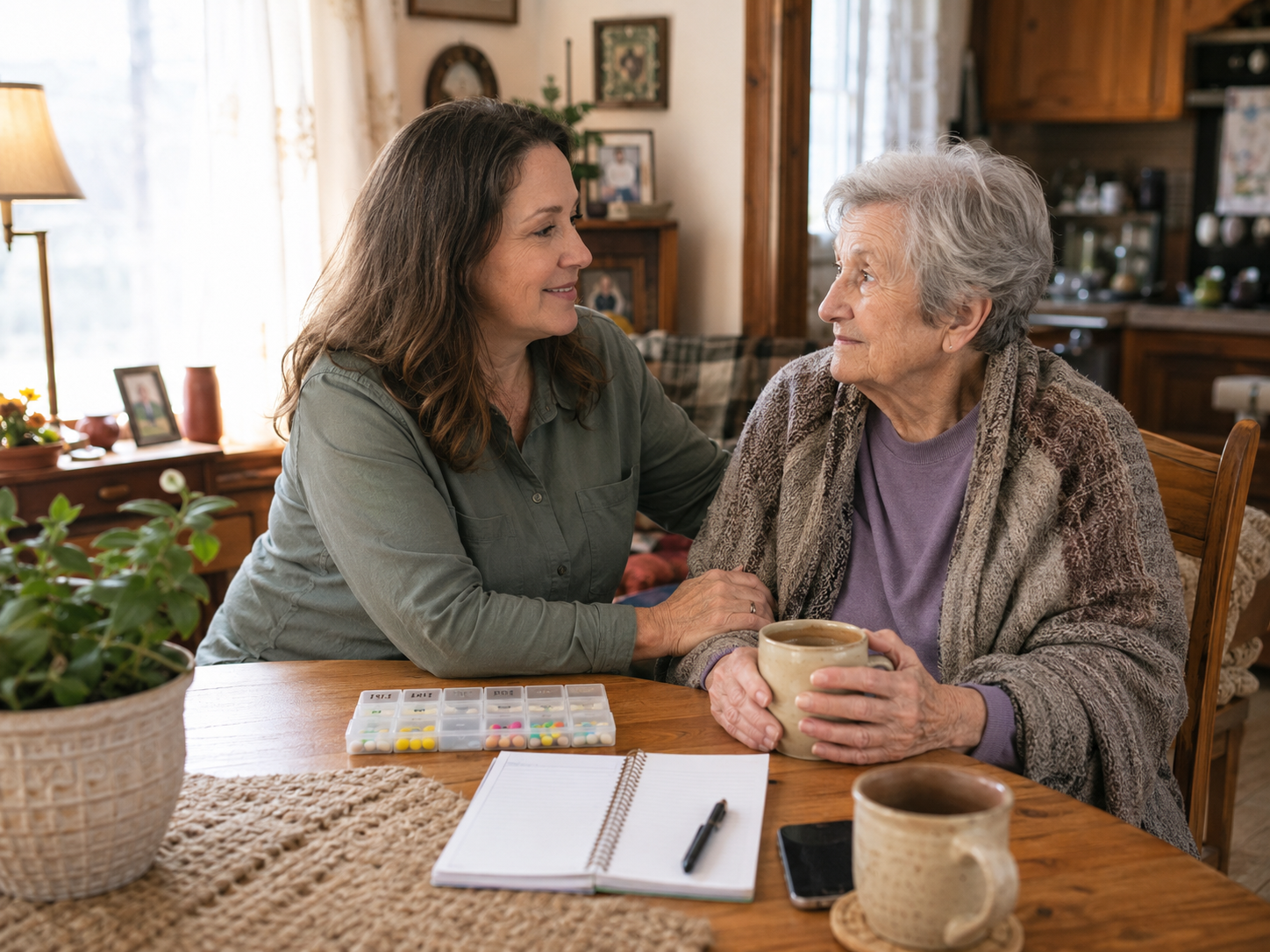
At first, it may look like checking in more often. Then it becomes managing medications, repeating the same answer several times in an afternoon, turning off the stove, helping with bathing, watching for wandering, and sleeping lightly because you are listening for movement in the next room.
By the time many families call it caregiving, they have already been doing it for months.
According to the Alzheimer’s Association, nearly 13 million Americans provide unpaid care for a family member or friend with dementia. Behind that number are families trying to keep someone safe at home while also managing work, bills, meals, appointments, and their own exhaustion.
This is where support matters. In-home dementia caregiving can be meaningful, but it is not simple. It takes structure, safer surroundings, different communication, and a willingness to ask for help before the whole situation is running on crisis mode.
For Arkansas families, the Arkansas Association of Area Agencies on Aging (5A) can help connect you with the Area Agency on Aging that serves your county, so you do not have to sort through every option alone.
What In-Home Dementia Caregiving Really Asks of Families
Families who take this on don’t ease into it. One day you’re helping with a few things. Then the few things multiply, and you realize the role has quietly become the center of your life. In-home dementia caregiving means you’re the one responsible for someone’s safety, comfort, and daily routine as their memory and judgment keep shifting. That responsibility doesn’t stay the same size.
Think about 6 p.m. on a Tuesday. Dinner is half finished, the phone is ringing, and the person you love is insisting they need to go home, even though they are already there. That moment is not unusual. It is Wednesday, too. And Saturday morning. And 2 a.m.
The work builds in layers.
Reminders come first. Then supervision. Somewhere along the way, you’re helping with bathing, managing a medication schedule, tracking appointments. That part you can plan for, more or less. What’s harder to plan for is what comes next, because it doesn’t announce itself. Incontinence. Swallowing concerns. A sudden agitation that wasn’t there last month. Nighttime confusion that didn’t used to happen. Mobility changes that showed up fast. Each new piece lands before the last one feels manageable.
And then there is the work no one sees.
Scanning the room for fall risks before you even sit down. Answering the same question for the fourth time while keeping your voice steady. Trying to read whether a behavior is the disease progressing, a medication reaction, or some signal of pain the person cannot name. That kind of vigilance does not clock out. It runs all day. It runs at night. And for most family caregivers, it wears them down faster than any of the physical tasks do, because there is no off switch.
Naming the full scope of the role matters. You cannot ask for the right support if you are still describing what you do as “just helping out.” If caregiving has started to feel bigger than one person can safely manage, that is not failure. It means the care needs have changed.
The plan needs to change with them. Structure helps. A predictable daily routine is one of the most reliable tools caregivers have.
A Steady Routine Can Calm More Than the Day
Routine doesn’t sound like much until you’ve watched it actually work. When someone with dementia has a predictable shape to their day, the brain doesn’t have to work as hard. Less guesswork. Fewer gaps where confusion rushes in. That’s not theory. Caregivers see it play out in real time, in smaller meltdowns, in mornings that actually end with everyone dressed and fed.
Your person woke up disoriented again. You got through it, but barely. That kind of morning is exactly what routine is trying to prevent.
Start with the anchors you already have. Breakfast. Morning hygiene. Lunch. A quiet activity. Dinner. Bedtime. Those touchpoints can hold the day together without turning your home into a posted schedule.
Rhythm matters more than precision.
Try to front-load the harder stuff. Bathing, appointments, anything that needs real cooperation tends to go better in the morning or early afternoon, before fatigue sets in. Late afternoons are rougher for a lot of people with dementia. Increased confusion toward the end of the day, sometimes called sundowning, is common. That’s not the time to push through a shower or a medical call. Save evenings for familiar routines, lower lights, and less.
When something isn’t working, stop. Just stop. Wait ten minutes, move to a different room, try again with less friction. A small choice helps too. “Blue shirt or the gray one?” lands differently than “You need to get dressed.” One question gives a little control back. The other just creates a standoff.
For more daily care guidance, Alzheimer’s.gov covers routines, communication, activities, and planning for changing needs. Alongside routine, a safer home environment reduces the number of ways the day can go wrong.
The Home Has to Change Before There Is a Crisis
Most families wait for a fall or a wandering incident before they start modifying the home. That window is too late.
Dementia does not just affect memory. It changes judgment, depth perception, balance, and the ability to respond to a hazard in time. A loose rug, a dark hallway, a burner left on. None of these look dangerous to everyone else in the house. For someone with dementia, any one of them can start an emergency.
Focus first on where injuries are most likely.
Loose rugs need to go or get secured to the floor. Cords belong off walkways entirely. Nightlights in the hall, bedroom, and bathroom make a real difference at 2 a.m. when someone is disoriented and moving fast. Keep frequently used items within arm’s reach so there is never a reason to climb. Grab bars near the toilet and in the shower are not optional at this stage. Non-slip mats go anywhere water collects.
The kitchen deserves its own walk-through.
Someone with dementia may forget a burner is on, turn on the wrong appliance, or mistake something unsafe for food. The National Institute on Aging recommends removing tripping hazards, checking locks, securing hazardous items, and revisiting safety changes as Alzheimer’s progresses. The Alzheimer’s Association recommends appliances with automatic shut-off features, stove knob covers, and clearing unsafe items from counters.
Do not wait for a wandering incident before thinking about the doors.
Locks placed higher or lower than eye level can reduce unsupervised exits. Door alarms add another layer. Interior locks, especially on bathrooms, need a separate review: the goal is making sure the person cannot accidentally lock themselves inside.
A lot of families push back on these changes, or at least slow-walk them. Removing knobs, adding alarms, adjusting locks can feel like you are taking something from someone who has already lost so much.
It is not. It is reducing the number of ways the day can go wrong. How you communicate through the day matters just as much as the environment you have set up.
Communication Gets Easier When You Stop Correcting
Nobody tells you when the rules change. But at some point they do. The goal stops being accuracy. It becomes something quieter: keeping the person calm, keeping them connected to you. Whether the facts are right stops mattering nearly as much as whether they feel safe.
Correcting every mistaken memory usually backfires. If your father says he needs to get to work, telling him he retired twenty years ago will probably make him more confused, not less, and you may get defensiveness or distress instead of a reset. A calmer move: “You always took your work seriously. Let’s have breakfast first, and then we’ll figure out the day.” You’re meeting the feeling behind the words, not the words themselves. That’s the whole game.
Short sentences. One question at a time. Not three. “What do you want for lunch?” is too much to parse, but “Soup or a sandwich?” gives the brain something to grab onto. Use their name. Step into their line of sight before you speak. If you need them to track something, turn off the TV, because background noise is harder to filter out than most people realize, and what looks like inattention is often just overload.
When a conversation starts to spiral, stop trying to win it. Redirect. Reassure. Come back to something familiar.
Some days nothing works. You will say the same thing six times before noon. You will have a conversation that goes sideways for reasons you cannot fully explain, and then twenty minutes later they will be calm and you will still be rattled. That is just what dementia caregiving looks like on the ground. But the confusion tends to ease, at least a little, once you stop treating it like stubbornness that needs to be corrected.
The person is not trying to make the day harder. The disease is. And when the weight of caregiving starts to exceed what one person can hold, that is the signal to ask for help.
When It Is Time to Ask for Help
Ask for help when safety, sleep, or caregiver health is starting to break down.
That might look like wandering, repeated falls, missed medications, aggressive behavior, unsafe cooking, or poor hygiene. It might also look quieter. You get sick more often. You lose patience faster. You miss your own appointments. You feel trapped by the routine of care, and you cannot remember the last time you slept through the night.
A crisis is not required. Reaching out before things get worse is exactly the right move.
Every county is different, and every family’s situation is different. Respite care is the most urgent need for some people. For others it is transportation, or meals, or just someone who can look at the full picture and say “here is what you qualify for.” You do not need to arrive with the right answer. You do not need to arrive with any answer.
The Area Agency on Aging that serves your county is the right place to start. They take this call every single day, from people in exactly your position, and you don’t need to know the correct program name or come in with the right terminology.
You can start with the plain truth:
“I am caring for someone with dementia at home, and I need help understanding what support is available.”
That is enough to get started.
Arkansas Support for In-Home Dementia Caregiving
Arkansas carved the state into eight regions, each anchored by its own Area Agency on Aging. All 75 counties are covered. Families have been turning to these agencies for decades, long before terms like “care coordination” entered the conversation, and that’s still the right place to start: your regional agency, not a search engine.
The Arkansas Association of Area Agencies on Aging connects families with one of eight regional Area Agencies on Aging. Depending on where you live, your local agency may offer care coordination, in-home respite care, transportation, Meals on Wheels, family caregiver support, senior centers, and more. Each county is covered. The range of what is available varies, but the starting point is the same everywhere.
Call yours directly. The Arkansas Agencies page lists all eight regions and the counties each one serves. Find the agency for your county, then pick up the phone and tell them what is happening at home. They know what actually exists in your area, not just what appears on a state website, and that distinction matters when you are trying to get help quickly.
If you are not sure what you need yet, the Information and Assistance service is designed for exactly that call. Families use it to get oriented before they know what questions to ask.
For caregivers specifically, Family Caregiver Support may include support groups, training, counseling, and respite options. Many agencies can arrange care for your loved one while you attend a group. That means the logistics are handled, not just the invitation.
Because often, the barrier is not willingness. It is the ten phone calls you do not have energy for, the question of who watches them while you go, the weight of knowing something needs to change but not knowing where to start.
Start with one call.
Find your local agency through Aging Arkansas, explain what is happening at home, and ask what caregiver support is available in your county.
Questions Arkansas Families Ask About In-Home Dementia Caregiving
Can someone with dementia stay at home safely?
For many families, home is the right place well into the progression of the disease. What makes it work is matching the level of support to where the person actually is right now, not where they were six months ago. Revisit the plan every few months, because dementia changes and the plan has to change with it.
What is the difference between dementia and Alzheimer’s?
A lot of families use the two words interchangeably, which makes sense because that’s how most people hear them used. But Alzheimer’s is actually one specific cause of dementia, and not the only one. Lewy body dementia and vascular dementia can look nearly identical on the surface. The difference matters because these conditions don’t progress the same way, and what to expect down the road can vary quite a bit depending on which one you’re dealing with. If the diagnosis feels unclear, it’s worth pushing your care team for specifics.
What should I do first if caregiving is becoming too much?
Contact your local Area Agency on Aging through Aging Arkansas. Ask specifically about caregiver support, respite care, care coordination, transportation, and meals. Staff can tell you what is available in your area and help you apply.
Does asking for help mean we cannot keep our loved one at home?
No, and honestly the opposite tends to be true. Families who bring in support early are usually the ones who manage to keep a loved one home longer. When caregivers get regular breaks, they stay sharper and less depleted, which means they’re actually more present during the moments that count. The harder path is waiting until everything feels like it’s falling apart, because by then some options are already off the table. Reaching out now, even just to ask what exists, leaves you more choices, not fewer.
You Can Start Before It Becomes an Emergency
Most families don’t call until something breaks. Don’t wait for that.
In-home dementia caregiving is hard because dementia keeps changing the rules. The routine that worked three months ago may stop working today.
The home that felt safe last year may need new locks on the doors, or a grab bar in the shower, or a deadbolt the person with dementia can’t figure out. And the caregiver? They’re often the last one to say something. Running on less sleep than they should be, holding it together, not wanting to admit how thin the margin has gotten. That’s not failure. That is the nature of this disease, and it catches most families off guard.
Nobody does this perfectly. What you actually need is a number to call when you don’t know what comes next.
Most families reach out after something goes wrong. A fall. A wandering incident. A caregiver who finally breaks down and admits they cannot keep going at this pace. But you do not have to wait for a crisis to call your local Area Agency on Aging. You can call because you have a question. Because you are not sure what help even exists in your county. Because you just want to talk to someone who works with families like yours every week.
That is what the Arkansas Association of Area Agencies on Aging is there for.
Visit agingarkansas.org to find the office nearest you and ask what support is available.

Leave a Reply